
Permissions
Permissions decide who may read, write and moderate in which category, and the whole thing is built out of two ideas: a default that applies to everyone, and groups that raise that default for their members.
Levels
There are four of them and they nest, meaning each one includes the one before it:
- None: cannot see the category at all, and it isn't listed for them in the first place.
- Read: may read.
- Read, Write: may read and post.
- Read, Write, Moderate: may read, post and moderate what is in there.
Default permission
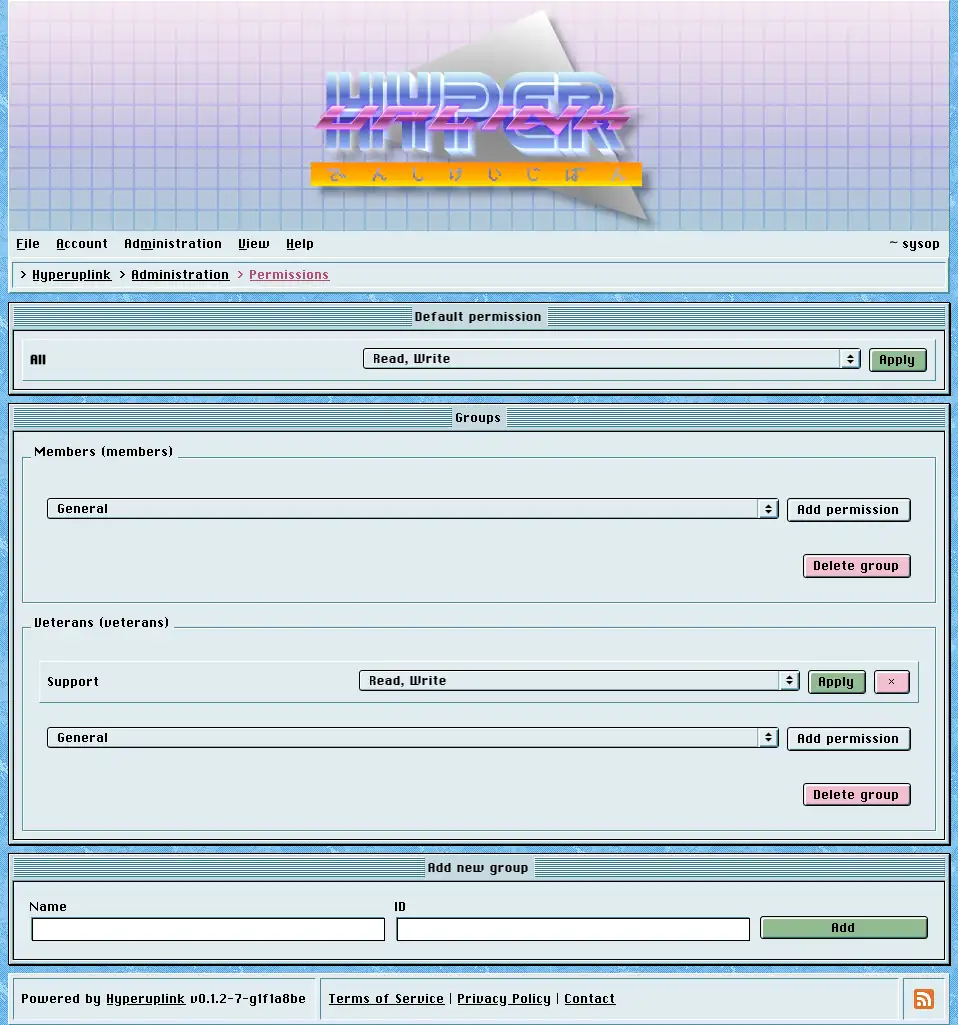
The top window sets the level for All categories and for everyone who isn't lifted above it by a group, meaning guests and signed-in users alike. This is the setting that decides what kind of board you're running:
- Read: a public board that people sign up to post in.
- Read, Write: a public board that everyone may post in.
- None: a board that shows nothing to anyone until a group says otherwise, which is where you start when the board is meant to be private.
Groups
The windows underneath are the groups, each with the categories it grants something in, and users are put into groups from their profile rather than from here. A group with no members grants nothing to nobody, and a user in no groups gets the default and nothing more.
Adding a group takes an ID and a name, the ID being what the permission rows point at, and Add permission then adds a category row to that group. A category that already has a row in a group cannot be added a second time, and the page shows a message once every category is mapped.
Resolution
A user's level in a category is the highest of the default and of every group they're in, which has one consequence worth being clear about: a group can only ever raise access and not lower it. A group set to Read in a category whose default is Read, Write changes nothing at all for its members, since they already had more than it grants.
Hence a private category is built by setting the default to None and granting the group what it needs, rather than by leaving the default open and trying to exclude one group. There is no deny rule.
Administrators aren't resolved through any of this and are never denied access. An admin account reads and writes everywhere, whatever the table is set to.
The page itself: Administration → Permissions
